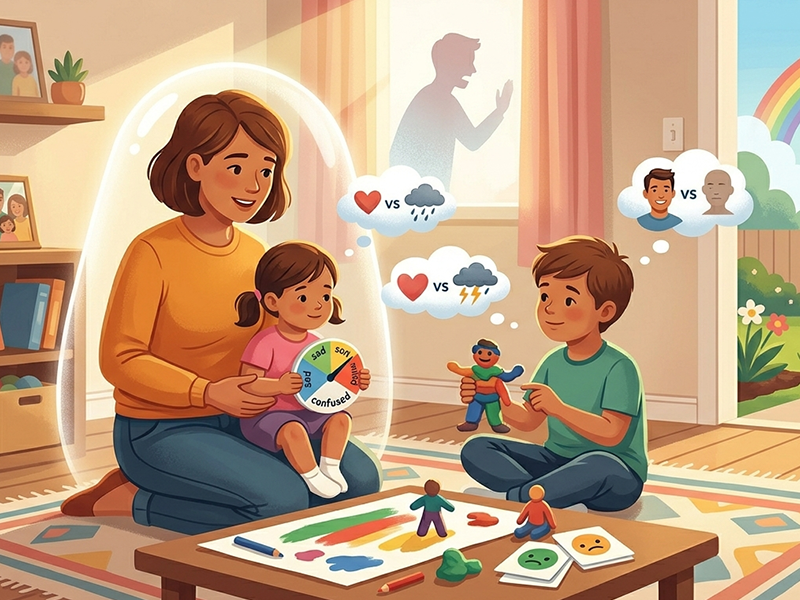
When a child is growing up in two homes—especially in a high-conflict co-parenting situation—they often carry emotions that are confusing, heavy, and hard to express. Love, loyalty, anger, sadness, and even guilt can all exist at the same time.
And here’s the truth many parents don’t realize:
Children don’t struggle because they love one parent more… they struggle because they feel like they’re not allowed to love both freely.
This blog will walk you through how to help a child cope with conflicting feelings about both parents, while protecting their emotional safety and strengthening your connection with them.
Why Children Feel Conflicted Between Parents
Children are naturally wired to bond with both parents. But when tension, conflict, or negative messaging enters the dynamic, it creates an internal tug-of-war.
They may feel:
- “If I love Mom, will Dad be hurt?”
- “If I miss Dad, will Mom feel replaced?”
- “Am I betraying one parent by enjoying time with the other?”
This is called loyalty conflict, and it can lead to anxiety, emotional shutdown, or even behavioral changes.
1. Normalize Their Feelings (Without Judgment)
Your child needs to know one thing above all:
Their feelings are safe with you.
Instead of correcting or minimizing what they say, validate it.
What to say:
- “It makes sense you feel that way.”
- “You can love both of us.”
- “You don’t have to choose.”
Avoid:
- “Don’t feel like that.”
- “That’s not true.”
- Speaking negatively about the other parent
When children feel emotionally safe, they begin to process instead of suppress.
2. Give Them Permission to Love Both Parents
This is one of the most powerful things you can do.
Children often carry unspoken guilt for loving the other parent—especially if they sense tension.
Say it clearly and often:
- “You are allowed to love Mom and Dad.”
- “No one can take anyone out of your heart.”
This aligns with your core message:
No matter how many homes a child has, they only have one heart—and it deserves to feel safe.
3. Don’t Put Them in the Middle
Even subtle behaviors can make a child feel responsible for adult emotions.
Avoid:
- Asking them questions about the other parent
- Using them as messengers
- Letting them hear adult conflict
Instead, protect their peace.
Child-focused parenting means:
- Adult problems stay with adults
- Children stay in their role: being kids
4. Teach Emotional Expression (Not Suppression)
Children need tools to understand and express what they’re feeling.
You can help by:
- Encouraging journaling or drawing
- Using feeling charts (“Are you feeling sad, confused, or both?”)
- Creating open conversations at calm moments
Ask gentle questions like:
- “What did your heart feel today?”
- “Was there anything that felt confusing?”
5. Be the Regulated Parent
In high-conflict situations, your child doesn’t need another emotional reaction…
They need a calm, steady anchor.
Even when things are frustrating, your response teaches them how to handle their own emotions.
Instead of reacting, try:
- Pausing before responding
- Speaking calmly and slowly
- Grounding yourself before engaging
A regulated parent raises an emotionally secure child.
6. Reassure Them It’s Not Their Responsibility
Children often internalize conflict.
They may think:
- “If I act better, maybe my parents won’t fight”
- “This is somehow my fault”
You need to release that burden.
Say:
- “This is not your responsibility.”
- “Grown-up problems are not for you to fix.”
This gives them permission to just be a child again.
7. Create Emotional Safety in Your Home
You can’t control what happens in the other home…
But you can control what your child experiences with you.
Create:
- Predictable routines
- Calm communication
- A space where they can talk freely
Your home becomes their safe place to land, no matter what they’re feeling.
Signs Your Child May Be Struggling
Watch for:
- Withdrawal or silence
- Acting out or anger
- Anxiety around transitions between homes
- Saying things like “I don’t want to hurt anyone”
These are not “bad behaviors” — they are unspoken emotions.
Final Thoughts: Protecting Your Child’s Heart
Helping a child cope with conflicting feelings about both parents isn’t about fixing everything…
It’s about creating space where they don’t feel torn in two.
When you:
- Validate their feelings
- Give them permission to love both parents
- Stay calm and emotionally safe
You give them something powerful:
The freedom to love without guilt.
And that is what builds true emotional resilience.