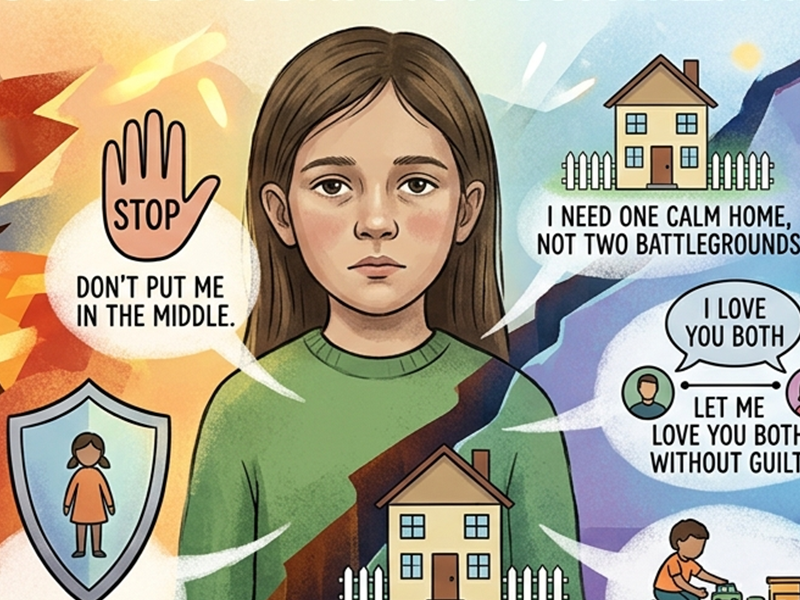
If children could sit both parents down and speak freely without fear of hurting anyone’s feelings, many of them would say the same thing:
“I wish you knew what this feels like for me.”
Children caught in high conflict coparenting situations often carry thoughts, worries, and emotions they never express out loud. They love both parents. They want both parents to be happy. They want peace. Yet many feel trapped in the middle of adult problems they never created and cannot solve.
While parents may be focused on court dates, schedules, communication challenges, and disagreements, children are often focused on something much simpler:
Feeling safe.
Feeling loved.
Feeling free to be a child.
“I Wish You Knew I Love Both of You”
One of the hardest realities for children in high conflict coparenting situations is feeling like they have to choose.
Children do not naturally divide their love between parents. Their hearts are big enough for both.
Yet when conflict becomes intense, children may begin to feel pressure to prove loyalty to one parent or hide their feelings about the other.
Some children stop talking about happy experiences they had with one parent because they fear upsetting the other.
Others become experts at changing the subject, keeping secrets, or managing emotions that should never be theirs to carry.
What children wish parents understood is simple:
Loving one parent does not mean they love the other any less.
“I Wish You Knew I Hear More Than You Think”
Children are always listening.
They hear comments made during exchanges.
They hear phone conversations.
They hear sighs, complaints, criticism, and frustration.
Even when adults believe children are not paying attention, children often absorb far more than parents realize.
What children hear can shape how safe they feel expressing themselves.
When negative comments become common, children may begin to feel guilty for loving the other parent.
No child should ever feel guilty for loving their mom or dad.
“I Wish You Knew I Am Not Responsible for Fixing This”
Many children become emotional caretakers without anyone realizing it.
They try to comfort one parent after difficult exchanges.
They hide their own feelings to avoid creating additional stress.
They become peacemakers, problem-solvers, and emotional support systems.
The truth is that children are not responsible for repairing adult relationships.
They are not responsible for managing adult emotions.
They are not responsible for fixing family conflict.
Children need the freedom to simply be children.
“I Wish You Knew How Much I Need Emotional Safety”
Children thrive when they feel emotionally safe.
Emotional safety means knowing they can talk about both homes.
It means feeling free to share happy memories without fear of judgment.
It means knowing they will not be punished, questioned, or made to feel guilty for loving either parent.
When children feel emotionally safe, they are more confident, more secure, and better able to develop healthy relationships.
When emotional safety is missing, children often learn to hide parts of themselves to avoid conflict.
“I Wish You Knew That I Notice Your Effort”
Children notice more than parents think.
They notice when a parent stays calm during a difficult situation.
They notice when a parent chooses kindness over conflict.
They notice when a parent listens without criticizing the other parent.
They notice consistency, patience, and emotional stability.
While children may not always say it, these moments create a foundation of trust and security that lasts a lifetime.
What Children Need Most
Children do not need perfect parents.
They do not need parents who agree on everything.
They do not need parents who never make mistakes.
What they need are parents who are willing to place their child’s emotional well-being above conflict.
They need parents who understand that every argument, every negative comment, and every loyalty conflict has an impact.
Most of all, they need permission to love both parents without conditions.
A Final Thought
If children could leave parents with one message, it might be this: “Please remember that I am watching, listening, and learning from the way you treat each other. I do not need you to be best friends. I do not need everything to be perfect. I just need to know that I am allowed to love both of you and that your conflict is not my responsibility.”
Because at the end of the day, children should never have to choose between the people they love.
Their heart is big enough for both homes.
And it always will be.